Typing without anyone knowing you're typing
University of Birmingham, UK · June 2026
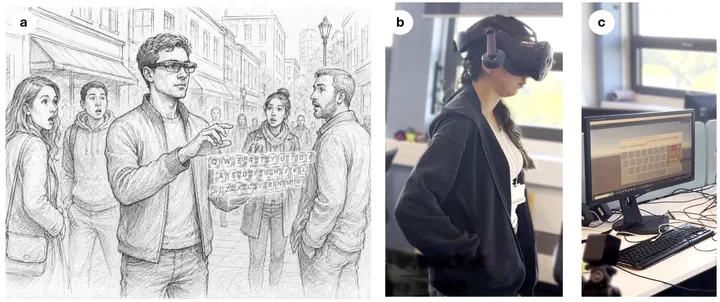
Text entry remains difficult on smart glasses and mixed-reality headsets. Speech is conspicuous and may disclose private content, while mid-air keyboards and pinch gestures can attract attention and become tiring. A new technique developed by researchers at the Universities of Birmingham and Cambridge explores a more discreet alternative.
Combining gaze with touch
Gaze is fast, but it is not a precise pointing signal. Eye movements contain natural jitter, tracking can drift, and a visible gaze cursor may encourage users to consciously steer their eyes. Implicit Gaze+Slide therefore treats gaze as an approximate, one-time prediction rather than a continuously controlled pointer.
The user looks towards a key on a virtual QWERTY keyboard and touches a phone held in the hand or pocket. At that instant, the system samples gaze and presents a 3 × 3 group of candidate keys around the estimated target. The user slides a finger to refine the selection and releases it to enter the character. After the initial sample, selection depends on the short finger movement rather than further gaze control.
Speed, accuracy and workload
In a controlled comparison, Implicit Gaze+Slide achieved 11.51 words per minute, compared with 12.54 words per minute for an explicit-gaze baseline; the difference was not statistically significant. Its character error rate was 5.49%, compared with 9.38% for the baseline. Participants also reported lower physical and mental demand on the NASA Task Load Index and a stronger perception of their own performance.
Perceived privacy
A separate survey asked 15 participants to assess videos of three techniques from a bystander's perspective. On a seven-point scale, Implicit Gaze+Slide received a mean perceived-privacy rating of 6.27. Gaze with a pinch gesture received 4.93, and mid-air keyboard tapping received 3.07. These results concern perceived discretion; they do not constitute a test of information security or resistance to deliberate observation.
Publication and video
The paper, Implicit Gaze+Slide: Discrete and Low-Effort Typing for MR Using Gaze-Based Prediction and Finger Motion Refinement, by Maisy M. Rapata, Jiaqi Tang, M. Eslami, Daniele Giunchi, Massimiliano Di Luca, Per Ola Kristensson and Eyal Ofek, is forthcoming in the proceedings of the 14th ACM Symposium on Spatial User Interaction (SUI 2026).
Adapted from Prof. Eyal Ofek's original research blog. Publication details were checked against Prof. Per Ola Kristensson's publication list.

Eyal Ofek
Chair of Computer Science
Eyal is Chair of Computer Science at the University of Birmingham (UK) in the School of Computer Science.