VR Lab Equipment and Resources
The VR Lab supports research, teaching and collaboration in virtual, augmented and mixed reality (VR/AR/MR), human-computer interaction, perception, movement science and creative technologies. The space combines configurable rooms, the dedicated VRLab Office, XR headsets, motion capture, haptics, audio-visual recording, physiological sensing and fabrication equipment.
If you would like to use the lab, start by identifying the space or equipment category that matches your project, then contact us to discuss access, training and practical requirements.
Spaces
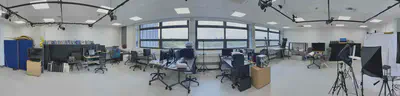
Main lab: A configurable room for meetings, workshops, demos, desk-based development and small-to-medium experiments.
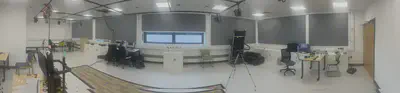
Motion lab: A larger tracking space for walking, treadmill, stationary biking and full-body motion capture.
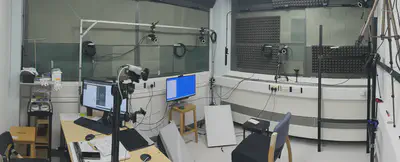
Camera lab: A recording and markerless capture space for audiovisual experiments, movement analysis and media production.
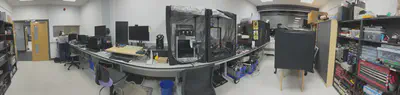
Workshop: A fabrication and prototyping space with 3D printing facilities for building mounts, experimental apparatus, interaction props and physical models.
VRLab Office: A dedicated office space for lab members, visitors and collaborators to plan studies, work between sessions and meet around ongoing projects.
Headsets
Our lab has a variety of headsets to meet diverse research and development needs. Headsets are available for research projects, student training, collaborative activities, and teaching.
Apple Vision Pro: Mixed reality headset with high-resolution displays, stereo pass-through, eye and hand tracking.
Magic Leap: Magic Leap 1 and Magic Leap 2 are advanced AR devices (see-through) designed for spatial computing and collaborative AR applications.
Microsoft HoloLens 2: Standalone AR headset (see-through) for holographic experiences.
Lenovo ThinkReality A3: Lightweight AR glasses (see-through) for enterprise applications.
Oculus/Facebook/Meta:
Meta Quest Pro: High-resolution standalone VR headset with eye tracking, hand tracking, and colour passthrough cameras.
Meta Quest 1, Meta Quest 2, and Meta Quest 3: Standalone or tethered VR headsets for a wide range of applications with hand tracking and passthrough cameras.
Pico 4 Pro: Lightweight, standalone VR headset with colour passthrough cameras.
HTC Vive:
Legacy headsets
We have a variety of legacy headsets including:
Oculus DK1 and Oculus DK2
Motion Capture and Tracking Systems
Best for movement science, avatar animation, interaction analysis, biomechanics, validation studies and real-time XR control.
Qualisys Optical Motion Capture: High-precision marker-based motion capture system (Oqus and Arqus). Provides sub-millimetre 3D tracking of body, hands, and objects, with real-time streaming to experimental software and XR engines.
Vicon Motion Capture: Optical infrared motion capture system enabling accurate full-body and object tracking for avatar animation, biomechanics, and validation of XR interaction experiments.
Qualisys Markerless Motion Capture: Multi-camera markerless tracking system that reconstructs full-body skeletal motion without reflective markers, allowing natural movement capture in behavioural and XR interaction experiments.
Microsoft Kinect (RGB-D Tracking): Depth-sensing cameras for markerless body and skeleton tracking, used for rapid prototyping, gesture interaction studies, and low-cost motion capture applications.
Tracking Gloves: High-accuracy wearable gloves for capturing fine finger articulation and detailed hand gestures during interaction tasks.
Leap Motion / Ultraleap: Compact optical hand-tracking devices for markerless tracking of hands and fingers in VR/AR applications.
Lidar Sensors: Intel Realsense devices for spatial mapping and environmental reconstruction, supporting mixed-reality interaction and AR scene integration.
Polhemus Fastrak: Electromagnetic tracking system for real-time 6-DOF position and orientation tracking of sensors. Suitable for precise tracking of head, hand, or object motion in VR and psychophysics experiments without requiring optical line of sight.
Audio-visual Recording and Presentation Equipment
Best for documenting studies, running presentations, capturing performance and creating controlled multisensory environments.
- Video Recording Setup: Professional-grade equipment, including black/white/green backdrops, stage lights, and contact microphones.
- Audiocards: A variety of multichannel audiocards for sound research.
- 10 High-Quality Speakers: Configurable for immersive audio experiences and spatial sound research.
- Cambridge Research Display++: Specialized screens for experiments requiring precise visual presentation.
Haptic Devices
Best for touch, force feedback, tactile perception, sensory substitution and embodied interaction studies.
- Ultraleap: Touchless haptic feedback for interactive VR experiences.
- ForceDimension Delta 3: High-performance force feedback for advanced interaction.
- Phantom Devices: Including Phantom Desktop, Phantom Omni, and Phantom Premium, offering detailed force feedback for tactile exploration and manipulation.
- Force Feedback Gaming Interfaces: Including driving wheels and joysticks.
- Pneumatic Interfaces: Pumps and valves for pressure and vacuum applications.
- Tactile Wearables: A variety of tactile and skin-stretch devices.
EEG/BCI Sensors
Best for studies involving gaze, physiological response, movement, muscle activity and brain-computer interaction.
- Emotive Headsets: Brain-computer interface (BCI) devices for recording EEG signals.
- Shimmer Wearable Sensors: Wireless wearable sensing platform for motion and physiological measurement (IMU, EMG, ECG, GSR). Used for recording body movement, muscle activity, and physiological responses during VR and human–computer interaction experiments.
- Tobii 5: State-of-the-art device for high-accuracy gaze tracking.
- Physiological Sensors: Comprehensive tools for monitoring biometric data, enabling studies of human responses in immersive environments.
3D Printing Resources
Best for building prototypes, custom mounts, experimental apparatus, interaction props and physical models.
The lab has a workshop with 3D printing facilities to support prototyping, experimentation, and development of physical models and devices. Our printers are organized into FDM and Resin (SLA/DLP) technologies to meet a wide range of needs.
FDM Printers
FDM printers are ideal for creating functional prototypes with different materials and large models.
- Creality CR-10
- Creality CR-10S
- Bambu Lab X1C
- Flashforge Creator PRO2
Resin Printers (SLA/DLP)
Resin printers are perfect for producing high-detail models with smooth finishes.
- Anycubic Photon S (2)
- Peopoly Phenom